

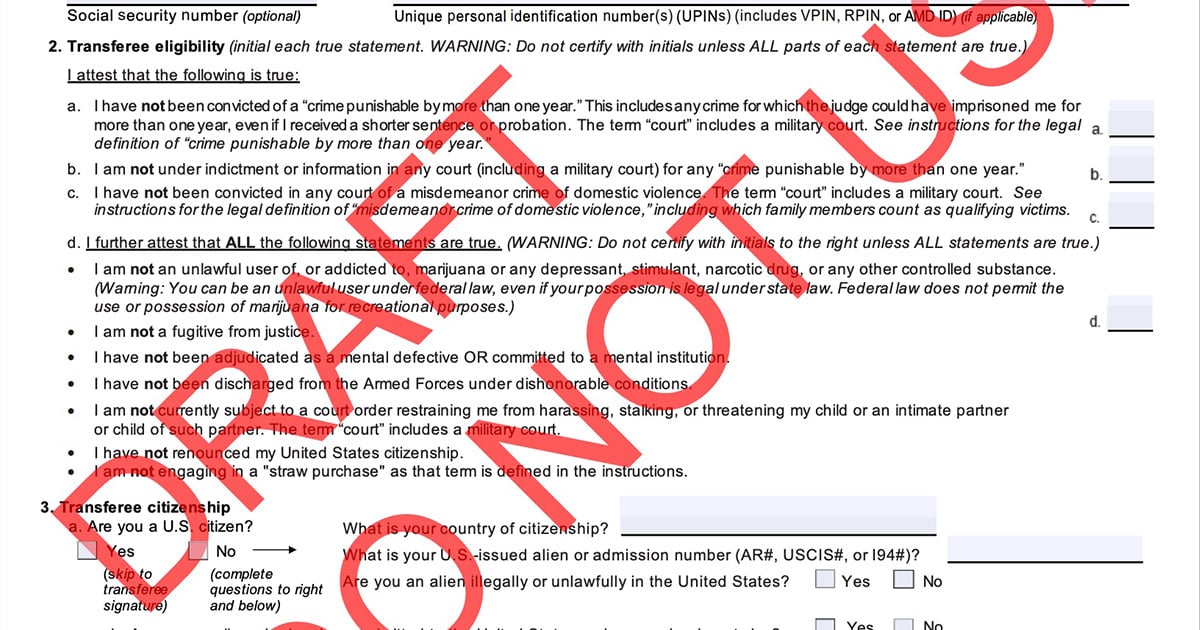
WASHINGTON, DC — The Bureau of Alcohol, Tobacco, Firearms and Explosives has published a draft of a revised Form 4473, the firearms transaction record every gun buyer fills out when purchasing a firearm from a Federal Firearms Licensee. The draft cuts the form down from seven pages to four and changes several of the questions buyers and dealers have been working with for years.
The draft was released as part of the broader 34-rule reform package the agency announced under Executive Order 14206, Protecting Second Amendment Rights, which I covered last week.
Sex Field Reduced to Two Options
The draft removes the “Non-Binary” option that was added under the previous administration. Buyers will now choose Male or Female, with instructions to select the sex they were assigned at birth. This change tracks with broader federal policy under Executive Order 14206 rather than functioning as any kind of restriction on who can purchase a firearm.
Question on Buyer Intent Rewritten Around Straw Purchases
The current form asks whether the buyer is the “actual transferee/buyer” of the firearm. The wording has long confused buyers and FFLs, since federal law has never prohibited buying a firearm as a gift for someone who is legally allowed to own one. The current language has been read by some buyers to mean exactly that.
The draft rewrites this question to specifically address straw purchases, which are the actual federal violation. The new question asks the buyer to indicate the purpose of the transfer with clear options: a transfer for the buyer themselves, a purchase the buyer is making with their own money as a gift for someone who is not a prohibited person, picking up a firearm being given as a gift or reward, or picking up a firearm that has been repaired for someone who is not a prohibited person.
The change should reduce confusion at gun counters across the country and protect family members and friends who have always been legally able to buy firearms as gifts.
Question 21b Removed
The current question 21b asks the buyer whether they intend to “sell or otherwise dispose of any firearm listed” on the form. Selling a privately owned firearm is not illegal in most circumstances, and this question has long led some buyers to believe the act of future resale was itself prohibited. The draft removes this question entirely. The intent of the question is now folded into the rewritten straw purchase language.
Marijuana Question Updated
Question 21f, the marijuana question, has been one of the more controversial sections of the current form. The current language sweeps in any marijuana use, including state-legal medical marijuana, as a federal disqualifier. That has put millions of state-legal marijuana cardholders in the position of either committing a federal felony by checking “no” or declining to attempt a firearm purchase at all.
The draft revises the question to remove references to medical marijuana and focus on recreational marijuana use. This change tracks with the federal rescheduling of marijuana from a Schedule I to a Schedule III controlled substance, which made clear that the federal classification of the drug is shifting in a less restrictive direction.
The Supreme Court has also signaled trouble for the federal prohibition on regular marijuana users possessing firearms in recent litigation, which makes the ATF’s revision of the form a natural step rather than a surprise.
Firearm Type Section Streamlined
The current form has the buyer specify whether the firearm is a long gun, handgun, or other, then has the FFL fill in the type of firearm separately. The two fields have produced mismatched paperwork errors that ended FFL careers under the previous administration’s zero-tolerance enforcement policy. The draft removes the redundant checkbox section. The new form also adds checkboxes at the top for “Firearms handler check only” and “Private party transfer only,” giving FFLs cleaner ways to handle non-purchase transactions.
The Big One: Direct Shipping
The most significant change in the draft is on page three. The new form includes an option for “Non-over-the-counter transactions,” which corresponds to the ATF’s separately published Non-Over-the-Counter Transfer rule. That rule allows FFLs to ship firearms directly to a buyer’s door rather than requiring the buyer to physically pick up the firearm at a gun shop, provided the FFL and buyer are in the same state.
This is the change the Second Amendment community has been talking about most. For buyers in rural areas or in states where the nearest FFL is not particularly close, direct shipping eliminates a meaningful logistical hurdle. It also brings firearms transactions in line with how nearly every other consumer good is purchased and delivered in 2026.
The Non-Over-the-Counter rule was published in the Federal Register earlier this week, and the Form 4473 draft adds the corresponding section to make compliance straightforward for FFLs participating in direct shipping transactions.
Why It Matters
A shorter form means fewer paperwork errors. Fewer paperwork errors mean fewer FFL revocations driven by minor administrative mistakes, which were a major focus of the previous administration’s zero-tolerance policy against gun dealers. A simplified straw purchase question reduces buyer confusion and keeps lawful gift transactions clean. A revised marijuana question recognizes that millions of state-legal medical marijuana patients should not be permanently disarmed under federal law. Direct shipping is a long-overdue modernization.
The draft is not yet final. Public comment periods are part of the ATF’s rulemaking process, and the Form 4473 revision will go through that process before it takes effect.
I’ll keep an eye on the comment period and the final published form as the rulemaking progresses.
Read the full article here