



This is the time of the year when men tend to hurt themselves. Lifting more than they should.
Later on today, Elaine and I will be moving a new 85″ TV into position. Sure, we MIGHT have called in (neighbors) to help. But where is the challenge in that?
But it gets me to a point that has been a cornerstone to “going rural” when not young: Learning how to do the most with the least effort.
Forces of Nature Harnessed in the Shop
Getting a lot done is mainly an engineering problem. We can hedge our success by looking at the dimensions and vectors involved.
Dimensions:
- TIME: This is the critical dimension – always. If you have a 1,000 hour project, it can be done in 1 hour per day for about 3-years. OR it can be done in 1 hour with 1,000 people each doing critical parts.
- HORSEPOWER: The human puts out ~about~ Ironman trained or better – one-third to one-half a horsepower peak. A few athletes will be able to put out 1 full horsepower for a few seconds. But when looking at shop work? Use 0.07–0.12 HP in your calculations. A bit more (sweat and salt are involved) and a bit less if aging.
- CALCULATIONS: Things like moving things can be calculated by computing horsepower (you) over time.
Vectors:
- UP: Moving something in the vertical plane involves its mass and gravity. That 32/ft/sec/sec stuff.
- Cheats
- Get a helper for lifting
- Use a rope.
- Use counter-weights.
- Jacks and or pulleys.
- Winches, come-alongs, portable cranes
- Cheats
- DOWN: Same problem except you have to remove force. This can be done using friction of opposite force.
- Cheats: Helper.
- Ropes
- (Helium balloons, dirigibles, uh…
- Jacks and/or pulleys.
- Winches or just shove the object over the edge.
- SIDEWAYS (FRICTIONS) – well, you have the idea by now – get creative with forces and time and suddenly everything gets easy. Trust you have a good hand truck? Some furniture dollies? Bring ’em along…
Shop Table Building Example
Shop Engineering being the focus today, we’ll go through a live-fire to show the “thinking” tools used.
So, Amazon is having their Black Friday sales preview a week back and I see a $99 adjustable height shop table. Ordered. Shows up with my FedEx (Cameron – sterling) guy. He hoists it onto the bed of the pickup truck.
- Engineering Detail: Why there? Because:
- Cam doesn’t have to bend over to put it on the ground.
- George doesn’t have to bend over to pick it up.
- Better? George can take a 60-70 pound lift off the risk assessment…
When comes time to move it into the shop, George simply wheels his hand truck into position behind the pick-up and slides the heavy box off the pick-up down onto the hand truck. He then lifts the (still on the truck) part to vertical and he’s ready to roll it into the shop. Note that the whole operation has involved 10-15 pounds of force so far.
Once in the shop, our hero (George, me, the old man…) looks for the perfect assembly location. He assessed how the table has been packaged and places it atop the shop garbage can.
As you can see, in the upside down position, I can sit in a comfortable shop chair and lollygag my way through the assembly process screwing in this and that. Because I’m comfortable, I can measure the adjustable legs so the whole thing will be within a quarter-inch of perfect when it’s salvaged from the madman assembling things.
Here’s the Secret Sauce!
 When you’re doing ANY project around your shop, spend a few minutes to carefully “size up” all conditions, gather in your tools, and remembering the forces involved. Stack the deck if your favor!
In this case, the hand truck brought the table in. So it fell onto the garbage can with minimal effort. And then I was able to lift (half the package weight) and slide it into position. Centered on the can.
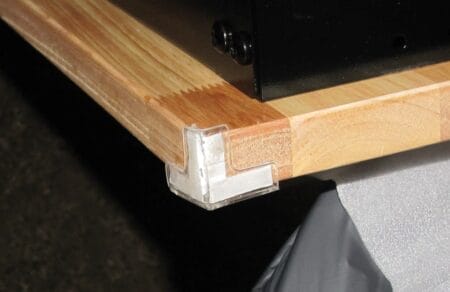
Taking the boxing off (listening to music, sitting in the office chair) wasn’t terribly tiring. but I was pleased to notice that the new table was protected by well-attached corner covers.
BINGO! This means that I would be able to slide this sucker off the garbage can when assembly was completed and still not worry about job quality – because it was baked in. With that, I slid the finished table onto the shop floor…
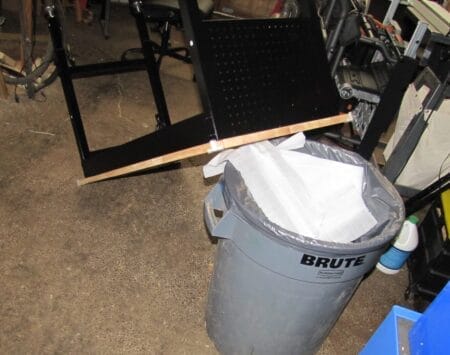
Pretty damn slick, huh? From here, it was a gentle tug and now the table was in the vertical axis, the little corner protectors giving me clearance to get the hand truck under and with that, into semi-permanent position,.
The Ham Radio Unboxing Example
Old ham radios – the BIG suckers from the 1936-1960 era tended to be heavy. Big transformers and lots of galvanized steel chassis. A typical receiver in the period can run 50-80 pounds (and more) while a transmitter can top 130 pounds. Clearly a health risk at 76 and almost 77.
Again, same technique: Although this time, the UPS fellow *Justin* knew I was expecting a heavy radio and he’s kind enough to put the radio right onto my hand truck out in the driveway. It goes into the shop to await it’s turn for unboxing, assessment, and eventual restoration.
Again similar technique – using the tip-over method – to get a box from upright to leaned over 45-degrees, and then the final short (reduced weight) heft into position.
In the case of this radio unboxing, I used a portable shop (motorcycle) jack. When loaded looked like this:

Between my hydraulic motorcycle lift and a couple of furniture dollies, I have no problem claiming I could get into the furniture moving business even when 80 and still get things moved. ‘Course you wouldn’t want to run a stopwatch on me, but once loaded, off it goes to the new table where it’s jacked up:
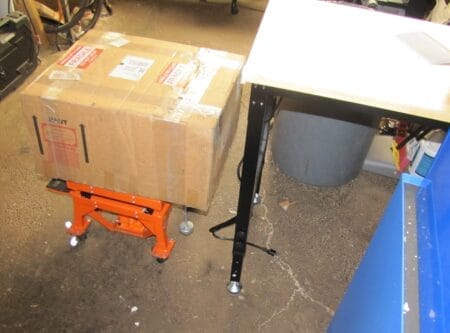
And then slid off the jack and onto the table.

With that, it was time for unboxing.
Worth It?
I will let you know when the radio is tested, restored to serviceable condition and a Q-Multiplier added to hot-up the CW (Morse) reception. But there’s a back-story to this style of radio that most people don’t know…

[Ham radio details of interest] If the dial on the left looks a bit yellowed? No telling how many packs of Camels via smoke have been attached by time to this old rig. Crud-Cutter and rubber gloves – we fix, you see! Getting the knobs off will involve those horribly over-priced Bristol spline wrenches I yammer about.
President Roosevelt had the same looking, but slightly earlier version of this radio (the SX-28) in the Oval Office during World War II. It was standard fare for listening to the BBC. No internet. The SX-28A came along with the old major change being the Lamb noise limiter circuit. Which wasn’t that good – since it never appeared in Hallicrafters production again. The SX-32 which is now in my hands, will mainly be used for shortwave listening in the evening and broadcast band DX’ing. And to listen to WW III on – but that’s not until 2H next year… This being the anniversary of the kickoff of WW II in the Pacific the first time…uh….
Occasionally, it will also see duty on Straight Key Night – which is the ‘vintage and tube radio’ event ham radio operators (like me) begin to salivate over. New Year’s Eve on a ham radio band near you.
Two for the Road
Two more useful “firehouse hints” from my youth – on the topic of heavy lifting.
First, if you have a real heavy lift, something on ground, consider lifting after first dropping to your knees.
Second: Get a couple of 2-by-6’s and cut them into 18″ hunks. When you lift a really, really heavy weight, lift one end or side 2″ and have a helper slide in the first hunk of 2-by. Repeat at the other end. Now, since the job is level, do a second lift, and so on. The weight raised will be half what normally has to be jerked and it’s just a hell of a lot easier. See-saw your way to desired height.
My friend Bob told me just yesterday “Don’t hurt yourself lifting that big TV into place.”
There is always risk when you’re moving things, but with no hurry, thoughtful planning, and stacking the deck (or 2-bys) in your favor, you can get an amazing amount of work done over time.
For everything else? The Kubota tractor bucket handles 500 pounds nicely. Pappy didn’t raise no fool.
Write when you need a lift,
[email protected] /ac7x
Read the full article here