



Long ago, back in the Beacon Hill basement shop in Seattle, Pappy and I got to talking about slotted screwdrivers. Now there’s a sentence that already dates a man.
Younger readers have grown up in a world of Phillips heads, Torx, Allen sockets, square drives, spline drives, and enough imported security fasteners to suggest modern civilization no longer trusts anybody with a screwdriver in the first place. But once upon a time, the humble slotted screw ruled the Earth. Radios, appliances, switch plates, junction boxes, furniture, machine tools — all of it held together with slot-head screws and optimism.
Pappy, being an old Seattle fire captain, treated tools with the kind of seriousness only old mechanics, firefighters, machinists, and shipyard men seem capable of anymore. Modern culture tends to think of tools as consumer goods. To those fellows, tools were extensions of judgment. If a man’s screwdriver was buggered up, there was a decent chance his thinking was buggered up, too.
I remember him sitting at the bench with a little triangular file touching up the blade of an old slotted screwdriver that looked perfectly fine to me.
“What are you doing?” I asked him. “Saving screw heads,” he said. And then came the lecture.
He explained that most slotted screwdrivers slowly round off at the tip with use. Once that happens, the blade stops making solid contact out at the edges of the slot where the torque actually belongs. Instead, the pressure migrates inward toward the centerline of the screw and the driver begins trying to climb out under load. Once that starts, the whole exercise deteriorates rapidly into stripped slots, profanity, and somebody eventually heading for the electric drill and a prehistoric ancestor of EZ-Outs.
Pappy hated that.
He explained that the very best machinist-grade screwdrivers often had their final little fraction of an inch honed dead flat instead of continuing the taper all the way down. That let the blade fully fill the slot instead of acting like a wedge trying to split firewood.
Then he told me about an idea he’d been carrying around in his head. He called it the “reverse-pitch slotted screwdriver.”
Which, honestly, sounded halfway between a machine tool patent and a Cold War submarine component. But the idea itself was clever.
His thought was that instead of continuously widening from the tip upward, the blade should fit the bottom of the slot perfectly and then actually narrow slightly for the next tiny fraction of an inch above the tip. Maybe a thirty-second of an inch. Maybe less.
His reasoning was beautifully practical. If the lower portion of the blade fully occupied the slot while the upper portion relieved slightly away, the screwdriver would resist “hop out.” It would stay engaged deeper into the screw head, tolerate imperfect alignment, and reduce the tendency of slotted drivers to cam out when torque increased.
In plain English, it would stay put better when a mechanic was leaned over sideways under a dashboard cussing at a frozen screw with sweat running into his eyes. Which, if you think about it, is exactly where most screwdriver innovation ought to happen.
The thing about old mechanics was that they thought geometrically. They didn’t use words like “ergonomics” or “human interface optimization.” They simply stared at failure long enough to understand why it was happening.
I never did anything with Pappy’s idea. I had my AI stack gin up some plans and I saved this one so you could get the idea of how it works:
At the time I was neck-deep in electronics work, radio gear, kids, engineering deadlines, newsrooms, and all the other rigmarole life stacks onto a man before he notices thirty years have gone by while looking for a missing nut driver.
Besides, the world quietly moved on.
Phillips screws took over because assembly lines liked controlled cam-out. Allen heads spread everywhere. Robertson square-drives appeared. Torx came along from the future like a mechanical gift from a civilization that actually respected technicians. Modern deck screws with spline drives now sink themselves into lumber with almost supernatural obedience compared to the medieval suffering once associated with brass slotted wood screws.
And somewhere in there, Pappy’s screwdriver became one of those good ideas history simply outran.
Still, I think about it sometimes because there’s something admirable in a man studying an annoyance deeply enough to redesign the geometry of the problem itself.
That lesson stayed with me.
Which brings us to another old shop problem: workspace.
Been Designing a Tool Bronco
Or more precisely, the complete and total absence thereof.
Back in the golden age of ham radio boat anchors, equipment possessed mass in the same way small moons possess mass. Today my little Hermes Lite 2 SDR setup sits quietly on a desk corner performing signal-processing miracles that would have required an entire wall of glowing vacuum tubes when I was younger. The modern little SDR rigs are astonishing. Five watts, digital signal processing, software-defined architecture, waterfall displays, filtering sharper than most lawyers, and enough flexibility to make a 1970s communications engineer weep softly into his slide rule.
But the old Hallicrafters gear?
Different universe entirely.
An HT-32B transmitter. SX-101 receiver that had been properly “breathed on.” HT-33B amplifier. Add the roll-around steel rack cabinet and you were already north of three hundred pounds before accounting for cables, microphones, manuals, spare tubes, patch cords, meters, and the accumulated archaeology of a technical life.
And the rack itself was no lightweight. Heavy-gauge steel with industrial casters large enough you could roll across a garden hose without slowing down. You probably could have rolled over a small child, too, though modern legal departments insist I clarify that no such testing was ever formally conducted.
The real problem came once you started servicing the gear.
A so-called “small” radio cabinet might measure nineteen inches across externally, but the moment you pulled the chassis, removed the cabinet, and opened things up for troubleshooting, the operational footprint expanded like federal spending. Suddenly the project occupied twenty-two inches sideways, thirty-six inches front to back, plus enough additional clearance for test leads, oscilloscope probes, soldering irons, alignment tools, manuals, coffee cups, extension lamps, and the screwdriver that had mysteriously vanished into another dimension despite having been in your hand four seconds earlier.
Old radio repair didn’t need a desk. It needed a loading dock. Forklift would have helped, too.
At one point Pappy wandered through the shop while I was losing a wrestling match against entropy and suggested a pull-out work surface like an old breadboard extension. I actually built one into a desk for a while. Worked beautifully, too. Pull the shelf out, set tools there, keep the primary bench clear for the radio chassis itself.
Elegant solution. Except for one thing. The desk stayed put. The work didn’t.
That realization hit me years later after I’d entered the modern age with 3D printers humming away in the background like robotic chickens laying plastic parts instead of eggs. Somewhere between printing brackets, cable organizers, SDR cases, and oddball adapters at two in the morning, I happened to glance down at my left forearm.
Now this is where inventors get themselves into trouble. Normal people see an arm and think “arm.”
Inventors see unused carrying capacity. And suddenly the Tool Bronco was born.
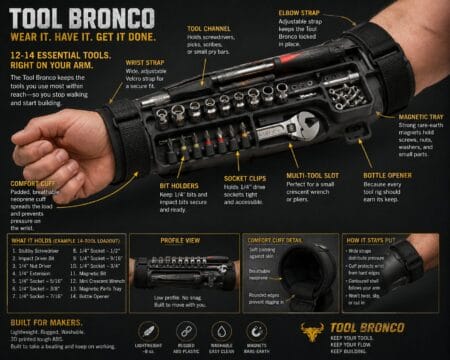
The idea is still evolving in my head, but picture something halfway between a wearable tool rig, a pit crew accessory, and a low-budget exoskeleton for aging makers who are tired of walking six miles a day inside their own shops looking for misplaced tools.
I was thinking about the Trinity Valley linemen here in Texas – out in a storm, shitty conditions -wouldn’t it be nice to have a few spare crimps somewhere besides a shirt pocket when it’s pouring or snowing and icing?
Of course, I’d do ONLY a left arm version of it. That’d be social justice for the lefty’s who outscore us righty’s in math because of how their brains work differently – I know – SJW is bad, but when comes to handedness in shop tools – oh, let’s not…
The Tool Bronco would mount along the forearm using broad Velcro straps at the wrist and just below the elbow. Lightweight but rugged ABS plastic, probably 3D printed in sections with reinforcing ribs and contouring so it wouldn’t rotate around the arm every time you reached for something. Not huge enough to become ridiculous. Just enough storage to carry the things you constantly need but constantly lose. Keep from running up and down the ladder – that kind of thing. Comfort cuff would make it long-term wearable and maybe that’s part of the anti-twist so the tools don’t dump out 2 stories up.
A magnetic strip for screws and bits. Socket retainers. Small crescent wrench. Stubby driver. Impact bits. Maybe a flashlight. Tiny magnetic pickup tool for recovering escaped hardware from the dimensional portal beneath every workbench. And yes, naturally, a bottle opener, because any civilization advanced enough to develop wearable shop infrastructure should still maintain proper priorities.
The older I get, the more I suspect most shop inefficiency has nothing to do with fabrication itself. The real time loss comes from stupid movement. Standing up. Sitting down. Hunting for tools. Forgetting why you stood up in the first place. Carrying screws from one side of the bench to the other. Looking for the 7/16 socket that vanished despite violating several known laws of physics in the process.
Comes with a second “blind” (Braille) tools so you can work in the dark with it, too…mind adds features for weeks on this kind of thing… MSRP $149 with basic tools and magnets.
Modern shops increasingly resemble memory exercises interrupted occasionally by actual work.
And somewhere in all this, I still see Pappy at the old bench with that little file touching up screwdriver blades because he understood something fundamental:
A good craftsman never stops refining the interface between human intention and physical reality.
Sometimes that refinement is a sharpened screwdriver. Sometimes it’s a pull-out shelf.
And sometimes it’s a ridiculous forearm-mounted wearable toolbox with a beer opener attached. That’s the Tool Bronco PPE/Medicine kit.
Wait!!!
Memo to G2 (the server farm build medical dir/ son)
“Hey son, anyone making an arm-mounted AED or gunshot kit for mass casualty events?”
Either way, the shop rolls on. Safely – for the first beer, anyway. Don’t suppose you’d be interested in my under-bra hanging small parts chest ideas? I need to sit in a crawlspace for a while and think.
Doing It Yourself
If you have an interest in the new/emerging hobby/job skill or AI, or if you have an interest in owning your own “sovereign AI” at home, then check out our Home AI Central website. For the more advanced concepts and evolutionary detective work, see the HiddenGuild.dev website.
If you’re waiting for big savings on tools and home improvement supplies? National Tool Slut Day is approaching. Amazon has already confirmed Prime Day gets dragged forward into June this year, though the exact dates remain undiscovered, as of this morning. Across garages, workshops, ham shacks, grow rooms, and home labs nationwide, TSD (tool slut disease) sufferers are already compiling emergency lists of “absolutely essential” purchases including thermal cameras, bench power supplies, cordless ratchets, mini-PCs, and at least three tools they didn’t know existed until YouTube suggested them.
As always, the first symptom is hearing yourself say, “I’m just waiting for Prime Day…” Current treatment options include paying retail (applying a thick covering of cash) or getting married which some users report does alleviate symptoms, though several methods of action are suspected.
Write when we’re wrong,
Read the full article here