

The Brief:
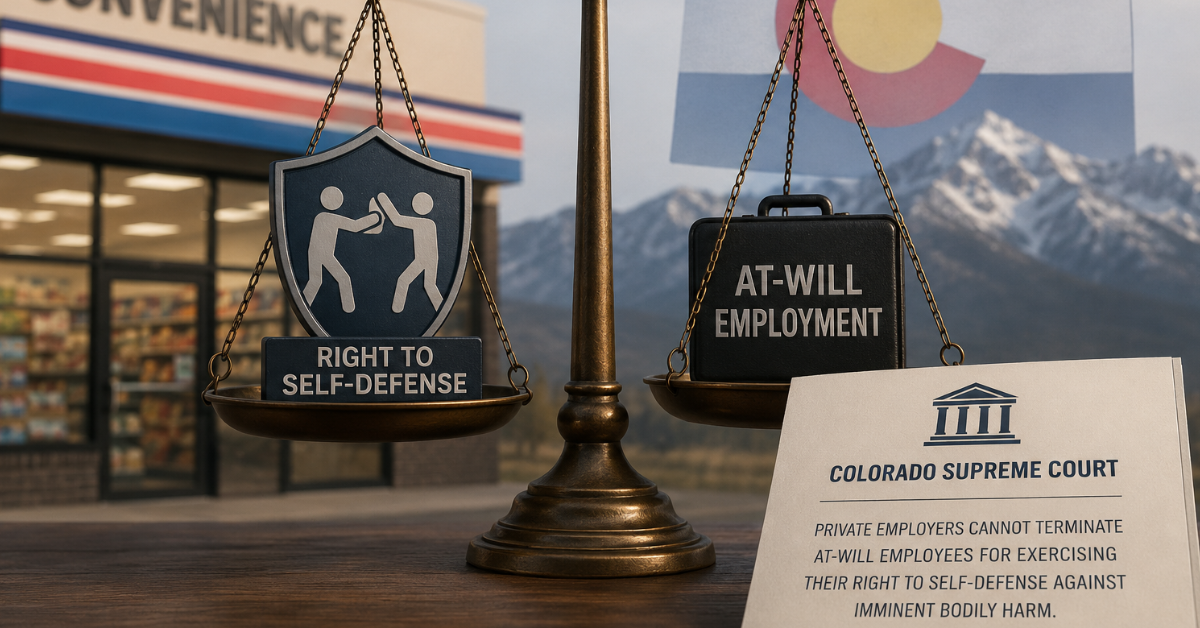
The Colorado Supreme Court ruled that private employers cannot terminate at-will employees for exercising their right to self-defense against imminent bodily harm. This decision, arising from a convenience store incident, establishes that corporate policies cannot override an individual’s fundamental legal privilege to protect their own life while working.
This ruling creates a specific public policy exception to at-will employment. While businesses can still enforce protocols against escalating non-violent thefts, they are prohibited from firing workers for lawful and necessary self-defense. This shifts the legal balance between corporate liability policies and individual safety rights.
DENVER, CO — A legal battlefield that has spent six years winding through the federal and state court systems has culminated in a massive paradigm shift for worker safety and the Second Amendment community.
Writing for the 5-2 majority, State Supreme Court Justice Maria E. Berkenkotter dismantled the long-standing corporate assumption that at-will employment agreements allow businesses to force complete submission from employees facing violent workplace crimes.
“The employment relationship should not be used to strip workers of the ordinary legal privileges every person possesses,” Berkenkotter declared in the historic June 15 opinion. “The right to self-defense has never been cabined by role or location… Rather, the right follows the employee from home to work and back and everywhere in between.”
The Origin: Trapped Behind the Register
The legal dominoes began falling in October 2020 at a Circle K convenience store in Westminster, Colorado. Cashier Mary Ann Moreno was cornered behind the counter when an individual wielding two hunting knives demanded free merchandise.
Moreno, feeling physically trapped and facing a lethal disparity of force, actively resisted the attacker, making physical contact with him to disrupt the ambush. While the encounter ended without serious injury to Moreno, Circle K corporate management reviewed the security footage and determined she had violated their strict corporate “Don’t Chase or Confront” policy. They promptly terminated her employment.
Moreno launched a wrongful termination lawsuit in federal court, arguing that firing an individual for defending their life violated Colorado’s public policy. Recognizing that this was uncharted legal terrain, U.S. District Court Judge Nina Y. Wang utilized a process called “certification,” pausing the federal trial to ask Colorado’s highest court to definitively clarify if state law protects a worker’s right to fight back.
The Corporate Backlash and Dissent
The ruling was met with sharp resistance from both corporate defense counsels and the bench’s minority. Chief Justice Monica M. Márquez penned a blistering dissent, joined by Justice William W. Hood III, warning that the court was overstepping by forcing private entities to absorb the liabilities of employees who violate company protocols.
Márquez argued that the decision would “tie employers’ hands and ultimately undermine workplace safety,” fearing it would prevent corporations from enforcing de-escalation strategies designed to protect human life over property. Circle K’s defense attorney, Thomas W. Carroll, echoed these concerns during oral arguments, stating, “We don’t need people jumping from behind the counter to stop someone from stealing a six-pack of beer.”
However, the majority clarified that its holding is narrow: it does not decide whether Moreno’s specific actions constituted self-defense, nor does it override an employer’s right to fire a worker who carelessly escalates a non-violent theft. Instead, it draws a bright constitutional line: if an employee’s actions are found by a jury to be a lawful and necessary exercise of self-defense against imminent bodily harm, a company cannot legally weaponize an internal policy to fire them.
The Broad Implications for the 2A Community
This victory addresses an immense tactical and legal vulnerability that millions of defensive carriers and workers navigate daily. For decades, standard corporate policy across retail, hospitality, and corporate America has demanded total compliance during an active threat, effectively forcing workers to trade their physical survival for their economic survival.
By recognizing self-defense as a deeply rooted public policy exception to at-will employment, the Colorado Supreme Court has delivered a powerful blueprint that gun rights advocates can now deploy in parallel court battles across the nation.
Safety Tip: While this ruling represents an extraordinary legal shield for employees in Colorado, workers nationwide must understand the critical tactical distinction between Defending Your Life and Defending Corporate Property. Circle K’s counsel argued that they want employees to disengage, which is actually a sound tactical principle when an actor is merely shoplifting items. Your firearm or physical force should never be deployed to protect an employer’s cash drawer or merchandise—retail items are insured, your life is not. However, if a criminal element closes the distance, traps you behind a counter, or deploys a deadly weapon (like the hunting knives in this case), de-escalation is no longer an option. In that fraction of a second, your priority must transition instantly from compliance to overwhelming counter-pressure. Know your state’s specific statutes regarding the “Duty to Retreat” in commercial settings, and ensure your defensive tool is staged where it can be rapidly accessed if an attacker breaches your workplace perimeter.
Read the full article here