

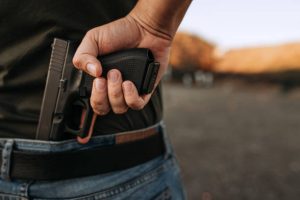

CCW Safe has released Lesson 3 in its ongoing Armed Defender’s Dilemma series, taking a sobering look at the legal consequences that can follow even a justifiable self-defense shooting. Through in-depth analysis, real-world case studies, and expert commentary, this lesson helps concealed carriers understand what’s at stake—not just in a confrontation, but in the courtroom.
Criminal defense attorney Don West describes self-defense as “an all-or-nothing proposition.” Once you admit to using force, your only legal defense is that your actions were justified. If the facts—or a jury—don’t agree, the penalties can be life-altering.
“Even if you survive the encounter physically,” said West, “you may still face arrest, indictment, trial, and years of uncertainty. It’s not just about being right—it’s about being able to prove it.”
Three Cases, Three Cautionary Tales
This lesson unpacks three cases where armed defenders faced criminal prosecution under vastly different circumstances:
- Daniel Perry, an Army sergeant and rideshare driver, shot an armed protester during a 2020 demonstration in Austin, Texas. Although he wasn’t initially charged, a grand jury later indicted him for murder after prosecutors revealed social media messages suggesting he anticipated violence. Perry was convicted—but later pardoned by the governor. Still, he spent years in legal limbo and over a year behind bars.
- Gerald Strebendt, a Marine veteran and former UFC fighter, shot an aggressive drunk driver in Oregon after a crash. Despite calling 911 and issuing verbal warnings, Strebendt was indicted for murder and held without bond. Facing damning character evidence, he accepted a plea deal to avoid a trial and served over two years in prison.
- Marissa Alexander fired a warning shot during a domestic incident in Florida. Although no one was injured, she was charged with aggravated assault under Florida’s harsh “10-20-life” law. She was convicted and sentenced to 20 years, only to have her conviction overturned on appeal. She ultimately accepted a plea deal for a reduced sentence—after already serving 1,065 days behind bars.
These cases demonstrate that even legally armed citizens with no malicious intent can face serious criminal charges, prolonged legal battles, and prison time.
Understanding the System
According to West, the process of facing criminal charges for a self-defense shooting is not simply a matter of “proving you were the good guy.” The burden of defending your actions can consume years, exhaust resources, and take a severe emotional toll—even if you ultimately prevail.
Prosecutors hold broad discretion over which cases move forward, and grand juries often rely solely on the evidence the prosecution chooses to present. As Lesson 3 explains, once you become a suspect in a shooting, you lose control of the narrative—and your future may rest in the hands of strangers.
Don West emphasizes, “We don’t make up the facts. We can’t change the facts. We help you deal, in the most successful way, with the facts.” That means the best defense is often not needing a legal defense at all.
Think Twice, Carry Smart
The lesson closes with a strong message to concealed carriers: think twice—not about whether you should carry, but about whether you fully understand the weight of that responsibility. Each time you carry a firearm, you’re stepping onto the field of a game you can’t leave until it ends—and one where the rules are complex and unforgiving.
As expert Doug Deaton puts it, once you use force, “you don’t get to step off the field again until that game is finished and completely finished.”
For those serious about carrying responsibly, Lesson 3 offers a powerful reminder: the aftermath of a shooting can be just as dangerous as the moment itself. Avoiding unnecessary confrontations, understanding legal principles, and preparing to articulate your actions under scrutiny are all part of what it means to live the armed lifestyle.
Lesson 3 is now available in full on www.ccwsafe.com, including a comprehensive article, expert podcast, and real case breakdowns.
Read the full article here